Operations
Club Staff Handoffs: What the Next Shift Needs Before You Leave
Give the next shift clear ownership, useful exception notes, and fewer loose ends with a practical club staff handoff and time-record review process.

The afternoon team arrives, the morning team leaves, and the club keeps moving. A delivery is expected. Someone has offered to cover part of tomorrow's opening shift. A room needs attention before an evening program. An employee forgot to clock out yesterday.
Each detail sounds manageable. But put one in a text message, another on a scrap of paper, and the rest in someone's memory, and the incoming supervisor has a puzzle to solve before they can get on with the day.
The consequences can reach beyond a frustrating changeover. An unconfirmed coverage offer can become an assumed assignment. An unfinished closing task can reach the next morning without an owner. A time-record question can remain unresolved until payroll preparation begins.
A useful shift handoff gives the next person enough information to act: what changed, what remains open, who owns it, and what happens next. Here is a practical process you can introduce without asking the team to write a report about everything they did.
Start with the next person's decisions
The receiving lead needs to answer four questions quickly: Are we covered? What is happening next? What has changed? Is anything waiting on me?
Build the handoff around those questions. A chronological account of the morning makes the reader search for the important part. A short description of an unresolved issue, its owner, and its next action gives them something to use.
“Talked to the evening supervisor about the multipurpose room” records an activity. “Evening program moved to the multipurpose room; supervisor will confirm setup by 4 p.m.” records an action and a deadline.
Use this editing question: If we remove the sentence, could the next person reasonably make the wrong decision? If the answer is no, it may belong in a completed checklist or a separate record.
Give the handoff an explicit covered period. “Monday opening through the afternoon changeover” tells the reader which work it represents. Add the outgoing lead, receiving lead, and acknowledgment time so responsibility for the transition is clear.
Use a one-page handoff with consistent fields
Keep the everyday handoff to one page or one screen, with links to fuller records when needed. Use the same fields each time so the incoming lead knows where to look.
| Field | What to record |
|---|---|
| Coverage changes | Confirmed changes, pending requests, uncovered periods, and the owner resolving each gap. |
| Next activity | Events, deliveries, room changes, or other work that needs preparation. |
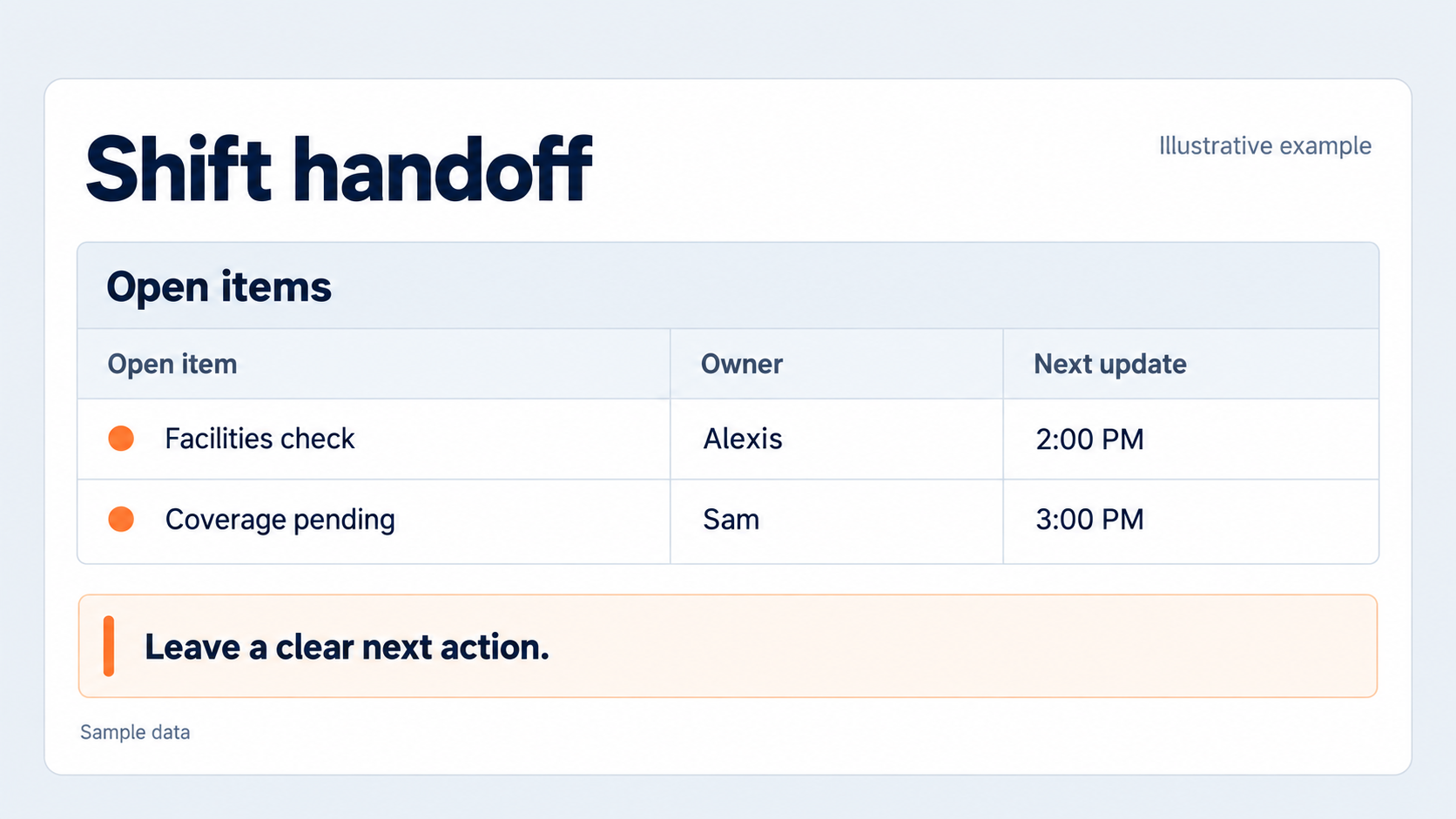
| Open work | Each unfinished item, its owner, next action, and deadline or review time. |
| Opening or closing exceptions | Checklist items that could not be completed and the plan for finishing them. |
| Time-record questions | A restricted record reference and review owner, without unnecessary employee details. |
| Confirmation | The receiving lead's acknowledgment and any question that still needs an answer. |
Write “none” when a section has no open items. A blank field leaves the reader wondering whether someone checked it. Give each item a recognizable name, such as “Tuesday delivery,” instead of a vague label like “follow up.”
Include an actual time or a clear event for the next update. “Before the 3 p.m. program setup” tells the receiving lead when the answer matters. “Soon” does not.
Make the template accessible from the place where the handoff happens. If completing it requires someone to leave their work area and find a particular computer, fix that access problem before adding more fields.
A completed entry might read: “Replacement supplies have not arrived. Office coordinator will check delivery status and update the order record by 3 p.m. Afternoon lead will review the update before preparing tomorrow's supply allocation.” Everyone can see both the action and the follow-through.
Keep coverage, ownership, and approval separate
A staffing conversation can contain three different questions: Who is expected to work? Who owns the next action? Who can approve the change? Keep those answers separate.
Suppose Morgan asks Taylor to cover the final hour of a shift. Taylor says they may be able to help. That is a pending request. It becomes a confirmed change only when the people required by your club's process have accepted it and the schedule has been updated.
Until then, show the original assignment, the proposed change, and the supervisor responsible for resolving it. Avoid “Taylor covering” while the arrangement remains uncertain.
The person reporting an issue does not have to own it forever. An employee might notice that supplies are low while a supervisor takes responsibility for ordering them. Record the transfer so neither person assumes the other is handling it.
“Manager aware” is not an endpoint. It does not explain whether the manager accepted responsibility or merely read a message. “Operations manager will confirm tomorrow's opening assignment before office hours end” gives the next shift a useful expectation.
Define a backup for decisions that cannot wait until the usual owner returns. The backup should know when to act and where to record the outcome.
If your team works across several facilities, attach the location to the assignment and the exception. “Opening lead” can mean different people at the pool, tennis courts, and clubhouse. Use the same location names the team sees on the schedule so nobody has to translate between systems.
Also identify which changes affect another team. Moving an evening activity may change room preparation for one group and equipment return for another. Assign one person to coordinate that change, then give each affected lead the action relevant to their work. Avoid copying a long thread and assuming everyone will recognize their responsibility.
When someone is covering an unfamiliar location, give them the current checklist and the contact for questions. The handoff can flag an exception, but it should not be their only source of instructions for the assignment.
Carry exceptions forward without copying every checklist
Keep routine opening and closing steps in the checklist appropriate to the role and location. Use the handoff for work that is incomplete, a condition that changed, or a task another shift agreed to finish.
If shared equipment has been returned to storage, mark that checklist item complete. If it remains in use for an approved late activity, record what remains out, who will return it, and who will verify completion.
Keep the exception open until someone confirms the result. Transferring it to the next shift changes ownership; it does not finish the work.
Describe observations clearly. “Storage cabinet would not latch during closing” says what someone saw. “The lock is broken” adds a diagnosis that may not have been established. The next person needs to know what to check.
Give an unresolved item its original date and next review time. When that time passes, ask the owner for an outcome or a revised plan. Repeatedly copying “still waiting” into tomorrow's handoff should prompt a decision about help, an alternative, or an accepted delay.
Move longer projects into the appropriate work list. A storage replacement project may stay open for weeks; the handoff only needs its current operational effect and the immediate action. Your club's established emergency and incident procedures remain the route for urgent situations.
Use the changeover to confirm what matters
Let the written record carry details someone may need later. Use the conversation to highlight decisions and confirm understanding.
The outgoing lead can start with three points: what changed, what remains open, and what must happen next. The receiving lead checks ownership and asks about anything unclear.
Acknowledgment means the incoming lead reviewed the handoff. It does not mean every item has been solved. Make that distinction clear when introducing the process.
Where shifts overlap, include the handoff in the planned work of the changeover. Where they do not, decide how the receiving lead acknowledges the record and where unanswered questions go.
For a busy transition, identify the one or two items that must be understood before the outgoing lead leaves. Keep the rest in the written record. Do not build the process around someone being available afterward to reconstruct the shift from memory.
Resolve time-record questions before the payroll handoff
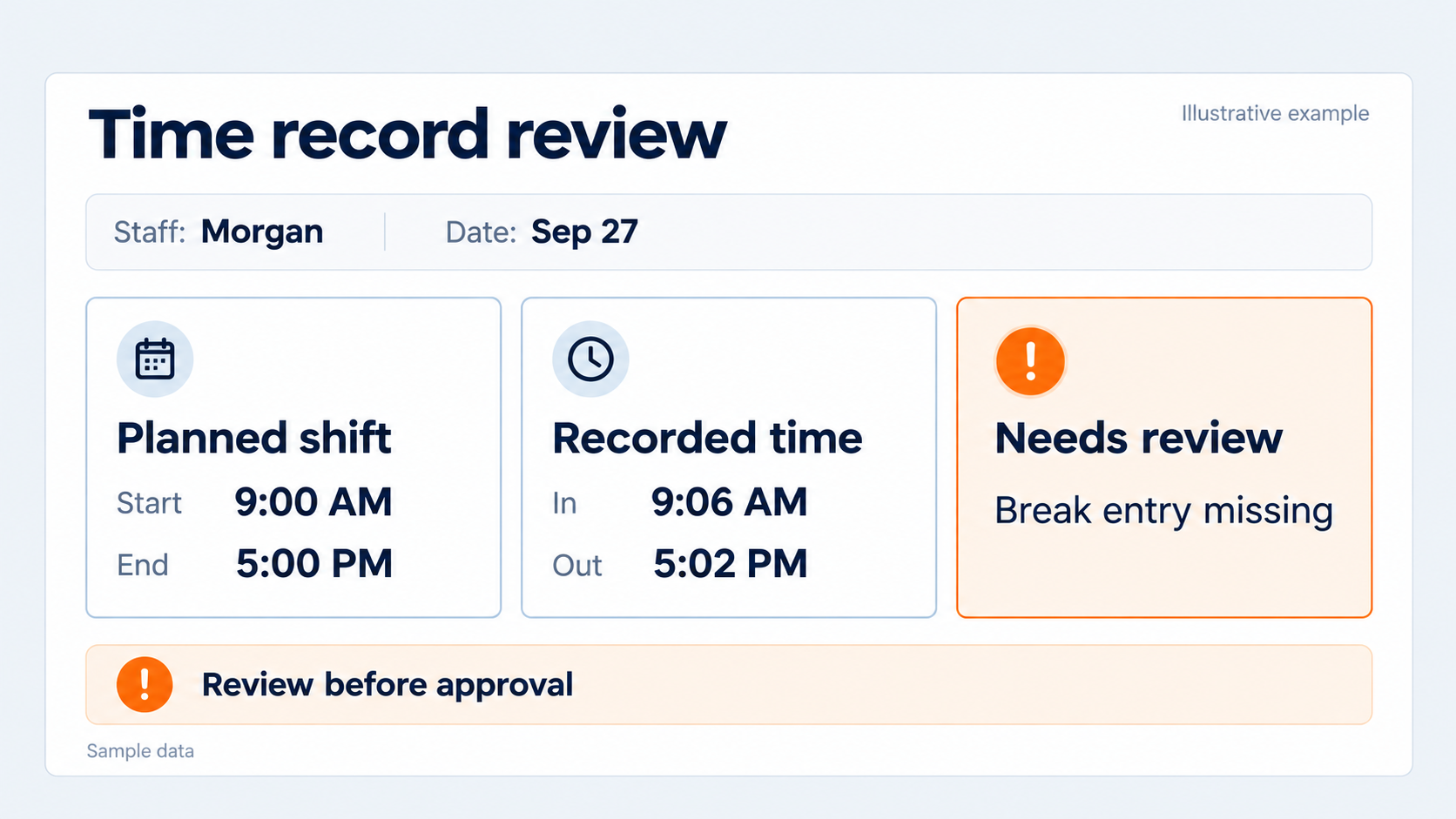
Treat the schedule as the planned assignment and the time record as the recorded work period. A difference between them is a question to investigate, not automatic evidence that the time record is wrong.
Assign a reviewer and a predictable review time. The reviewer needs a way to ask the employee or supervisor what happened, record the response, and track whether the correction process is complete.
Start with questions that identify an actual exception:
- Is a clock entry missing or attached to the wrong date?
- Does a coverage change explain the difference from the original schedule?
- Is a correction request waiting for an employee response or supervisor review?
- Is there enough information to understand the recorded work period?
An employee may have stayed to finish an assigned task. Changing the recorded departure to match the scheduled end would erase the question instead of resolving it. Establish what happened and follow your club's approved correction process.
Give each question an owner, the date raised, and a status such as awaiting response, awaiting review, or resolved. Keep supporting details in the appropriate restricted record. The general shift handoff should contain only the reference and action the receiving lead needs.
Separate attendance follow-up, time-record correction, and payroll preparation as responsibilities, even when one person performs all three. An attendance conversation does not necessarily settle the time record. A corrected time record does not mean payroll has been prepared or processed.
Before your designated payroll handoff, identify which records are ready and which still need attention. Every unresolved item needs a named owner and next action. Do not quietly assume the person preparing payroll will reconstruct what happened.
Define what “resolved” means before the team starts using that status. A supervisor receiving an answer is one step; completing the required review and recording the outcome is another. Close the question only when the relevant record reflects the approved outcome and any remaining action has an owner.
For instance, an employee might confirm a departure time while the correction still awaits review. The status should show that remaining step. Otherwise, the next reviewer could interpret the employee's response as a completed correction and pass along an unfinished record.
Use the review history to find process gaps as well. If several questions originate from the same unclear instruction, update that instruction and explain the change to the team. Resolve each individual record through the normal process while also addressing the source of the confusion.
Practice the situations that create confusion
A coverage offer is still pending
The outgoing supervisor has a message offering coverage for tomorrow's opening shift. The assigned employee knows about it, but the required approval has not happened.
Record the request as pending and name the supervisor responsible for confirmation. Keep the current published assignment clear until your process finalizes the change. The incoming lead should not have to infer approval from a screenshot of a conversation.
A closing task depends on a late activity
An evening program is still using supplies that normally return to storage before the closing lead leaves. Record who accepted the return task and who will check it.
If nobody has accepted responsibility, the task remains unresolved. “Evening team knows” does not assign the work. The manager needs to name an owner or change the plan while someone is available to carry it out.
A departure time is missing
A reviewer finds a missing clock-out entry from yesterday. Open a correction question, route it to the appropriate people, and record the response through the established review process.
Include it in the general handoff only if the incoming lead has an action. Leave personal circumstances in the restricted record, and do not fill the gap with an assumed departure copied from the schedule.
Introduce the handoff in one team first
Choose one regular changeover where responsibility genuinely changes hands and a supervisor can review the process. Show the team a completed example. A blank form leaves people guessing how much detail you expect.
Agree on where the record lives, who completes it, who receives it, and what happens when the usual lead is absent. For each type of issue, choose one authoritative record. Maintenance detail belongs in the maintenance record; the handoff points to its current operational effect.
During the first week, ask the incoming lead which entries helped and which still required a separate conversation. Look for unclear ownership, missing review times, and duplicated information. Remove fields that produce no useful decision.
Check a small sample of handoffs for accepted owners, actionable next steps, and follow-up on overdue items. For time records, check whether questions are resolved before payroll preparation and whether unfinished reviews have clear ownership.
A recurring coverage gap or unfinished closing task may need a change to the underlying plan. Bring repeated rework into your next season's budget review so time spent chasing answers can inform your process and platform priorities.
Connect the handoff to the tools your team uses
The handoff format gives you a practical starting point for evaluating a platform: can your managers find the schedule, understand coverage, and review recorded hours with the relevant context?
Clubward's staff scheduling and time tracking connects schedules and time records, supports coverage planning around facilities and positions, and provides for reviewing hours before the payroll handoff. Payroll Processing is a separate offering currently marked Coming soon on that same feature page.
The broader staff operations workflow also brings together position-based access, club-defined procedures, and guidance for staff and volunteers. Capabilities vary by plan and selected modules, so use your own changeover requirements to establish the right fit.
Bring one real coverage change, one unfinished closing task, and one time-record question to the conversation. Those examples give you a concrete way to assess whether the workflow helps the next person start with what they need.
Book your Clubward demo and walk through your club's scheduling and time-review needs with the team.
From Katelyn Pauley
More from Clubward