Operations
Guest Check-In: Give Your Front Desk a Clear Answer Before the Next Busy Day
Give your front desk a practical guest admission checklist, a clear exception path and records the next shift can understand.

A member arrives with two guests. One has a pass from last month. The other plans to pay at the desk. The member says a manager approved everything, but the person working the entrance cannot find that approval. Meanwhile, the next household is waiting.
The question is simple: can these guests enter? The answer depends on information scattered across a policy, a membership record, a payment and someone's memory. Asking the newest employee to assemble all of that while keeping the welcome friendly is a lot to put on one person.
A better guest check-in process connects three things: the rule, the admission decision and the visit record. Give staff a short path to the answer, define who can resolve exceptions, and leave a record the next shift can understand. Here is how to put that into practice.
What an unclear answer leaves for the next shift
Picture the same visit after a shift change. The guest returns from the parking lot, but the new employee cannot see whether the earlier conversation ended in approval. They ask again. The member repeats the explanation. Someone checks whether payment happened, and a supervisor gets another message.
That is the work worth removing: repeated questions, decisions that need to be reconstructed, and corrections nobody clearly owns. Your goal is not to eliminate every unusual arrival. It is to handle each one once and carry the answer forward.
Use a practical test: could a colleague who was not present explain what happened from the record? If the answer requires finding the original employee, the handoff is incomplete. Improving that one point can make the next change to your guest process much clearer.
Start with one decision path
Before adding fields or rewriting the handbook, describe admission in ordinary language. For example: “A guest can enter when the sponsoring membership is eligible, the visit meets our guest rules, and the required pass, payment and acknowledgment steps are complete.” Your club determines what each condition means.
Turn that sentence into a sequence staff can follow:
- Identify the member or household sponsoring the visit.
- Confirm whether that membership can bring guests today.
- Check the applicable guest type, allowance and date restrictions.
- Complete the required pass, payment and acknowledgment steps.
- Record admission, or send the unresolved question to an authorized person.
Put eligibility before payment. If a visit requires approval, find that out before collecting money that may need to be returned. If renewal questions regularly delay the eligibility check, use the membership renewal checklist to review what members and staff need to know before arrival.
Give every unresolved condition a next action. “Needs review” is a status; “Contact the duty manager before admission” is an instruction. The desk guide needs both. Include what staff should do when that person is unavailable, so an unanswered message does not become an invitation to invent policy.
Make the policy usable at the entrance
Choose one approved guest policy as the reference. Give it an owner, an effective date and a location the desk can access. Update the short desk guide whenever that policy changes, and retire old copies from the places staff actually look.
Check the terms that require interpretation. “Member must be present” could mean arriving together, remaining on the premises or being available by phone. Your approved policy should supply the answer. The desk guide should use that answer instead of repeating the ambiguity.
Keep temporary arrangements distinct from standing rules. A holiday restriction applies to a defined date. An event admission arrangement applies to that event. A courtesy approval for one household should state its limits.
Also compare the guide with member-facing messages. If a welcome email describes one allowance and the desk applies another, staff need management to resolve the difference. Use the same terms for guests, passes and visit limits wherever members encounter them. The person welcoming a guest should not have to choose which document to believe.
Separate the person, the pass and the visit
These three records answer different questions. The guest is the person arriving. The pass represents an entitlement under your policy. The visit records what happened on a particular date. Payment is another related event, not a substitute for recording admission.
For example, a member might buy passes on Thursday for guests expected Saturday. One guest cancels. The purchase happened, but that guest was never admitted. Another guest might arrive under an approved complimentary arrangement, creating a visit without a paid transaction.
Use status language that makes those differences visible. A pass might be available or used. A visit might be awaiting a decision, admitted or canceled. Payment can have its own status. Avoid using one label to carry all three meanings.
Build the record around the minimum information needed to make or explain the decision: sponsoring membership, visit date, guest information required by policy, admission type, outcome and responsible staff member. Add an approval reference when necessary. Leave out personal details that do not serve the operational purpose.
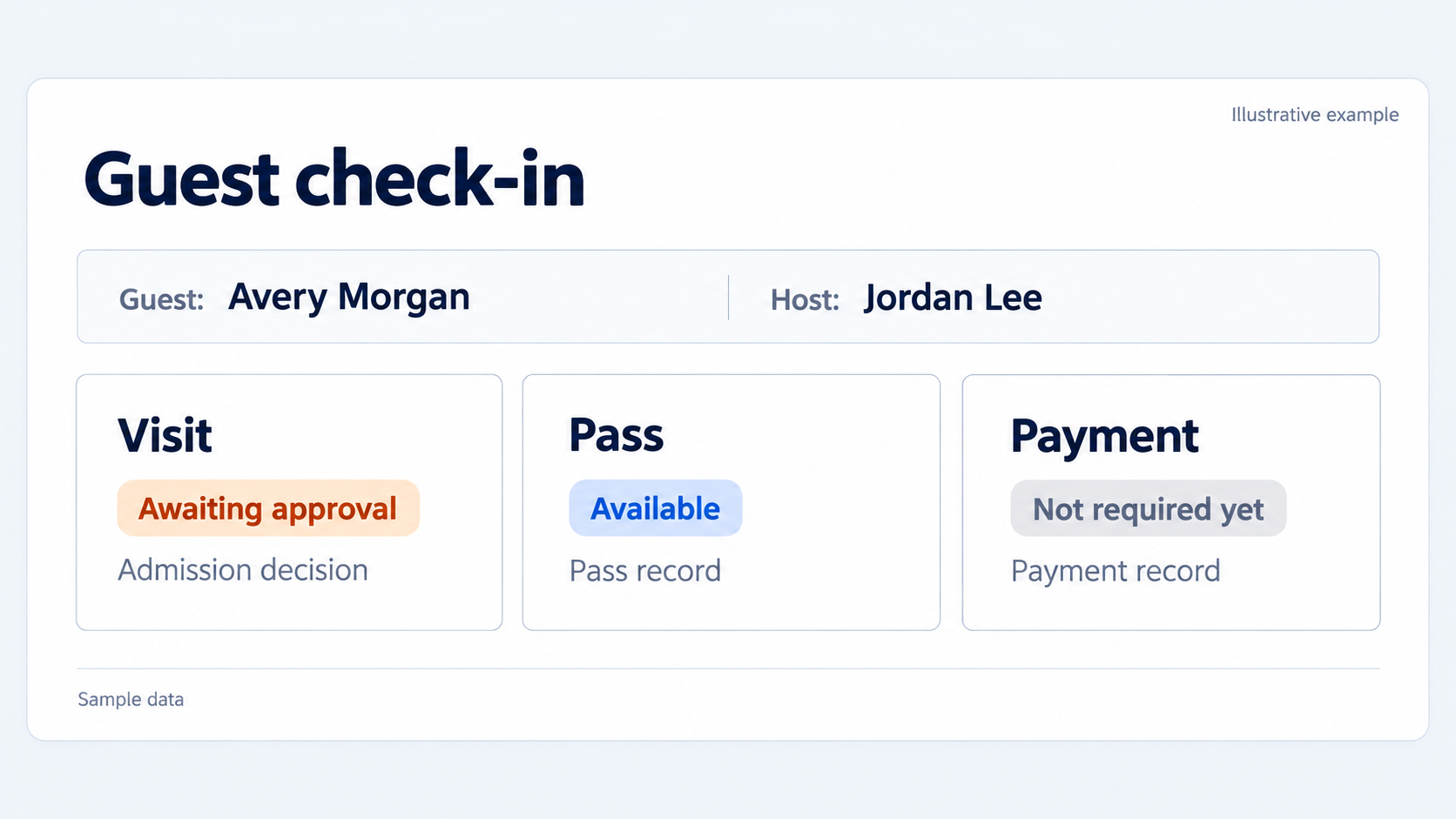
Use the distinction when checking your current process: can someone tell whether a guest entered without guessing from a receipt or a remaining pass balance? If not, clarify the visit record before adding more detail elsewhere.
Give staff a checklist they can finish
A useful desk checklist asks short questions and makes the next action visible. Adapt this one to your approved rules. Remove conditions you do not use, and make any facility-specific differences clear before staff begin.
- Sponsor: Which eligible membership or household is responsible for this visit?
- Visit: Is this the correct date, facility and admission type?
- Allowance: Does the visit fit the applicable guest allowance and restrictions?
- Requirements: Are the required acknowledgment, pass and payment steps complete?
- Decision: Is the guest admitted, awaiting approval or not proceeding?
- Handoff: Can the next person understand the outcome and any remaining task?
Keep the escalation contact beside the checklist. State which role can decide, how staff should reach that person during operating hours, and what happens while the answer is pending.
Then ask someone who did not write the checklist to use it. Give them one ordinary visit and one exception. Watch for the point where they have to guess. That is the instruction to improve, rather than adding another page of general guidance.
Resolve payment questions before they become duplicate charges
If payment is required before admission, state that plainly. If a household can be charged later under an approved arrangement, define who can authorize it and what the record must show.
When someone says they have already paid, give staff a way to locate the transaction or request a review. Avoid collecting payment again simply because a receipt is difficult to find. Staff might search by household and date, then ask an authorized person to resolve anything still unclear.
Record complimentary admissions too. A zero payment does not explain the decision. Capture the approved reason and the approving person using your established categories.
Keep the guest informed with specific language: “I am checking the payment record with the duty manager before we make any changes.” Do not promise a refund, immediate approval or an outcome the employee cannot authorize. Say what is happening next and who is handling it.
Make every exception specific
“The manager said it was fine” does not tell the next employee who approved what, for whom or for how long. Use a compact exception record that captures the decision without collecting a personal narrative.
- The sponsoring household and visit date.
- The usual rule that requires a decision.
- The exact approval, including any limit or condition.
- The approving person and approval time.
- Any remaining task and its owner.
For example: “One additional guest approved for today's visit only. Approved by the duty manager at 11:15 a.m. Standard guest fee applies.” This explains the exception without changing the standing allowance for future visits.
Define the authority behind the note. Correcting a duplicate entry and changing a guest limit are different decisions. Your club should decide which roles can handle each one.
While approval is pending, a simple script helps: “This visit needs manager approval under our guest rules. I can contact the manager now and explain what we need.” Decide where the guest can wait and who continues checking in the next household. The words need a workable handoff behind them.
Correct the visit and review its connected records
A canceled visit is different from a duplicate entry. A guest who never entered has a different history from someone admitted under the wrong household. Use the appropriate correction process and record why the change was made.
Then review the connected items individually: was a pass used, was payment collected, does the guest allowance need adjustment, and is a refund decision required? Changing the visit status does not establish that every related adjustment has been completed.
Consider a family that changes plans before entry because of rain. Record that no admission occurred, then follow your club's cancellation and payment rules. If they had already entered, use the policy for an interrupted visit. The description “we did not stay” is not enough to decide which event occurred.
Give unresolved corrections a named owner and a next step. “Manager to review the payment tomorrow” is easier to act on than “check later.” Preserve the relevant context so the guest does not have to explain the same situation to each shift.
Close the day by explaining the differences
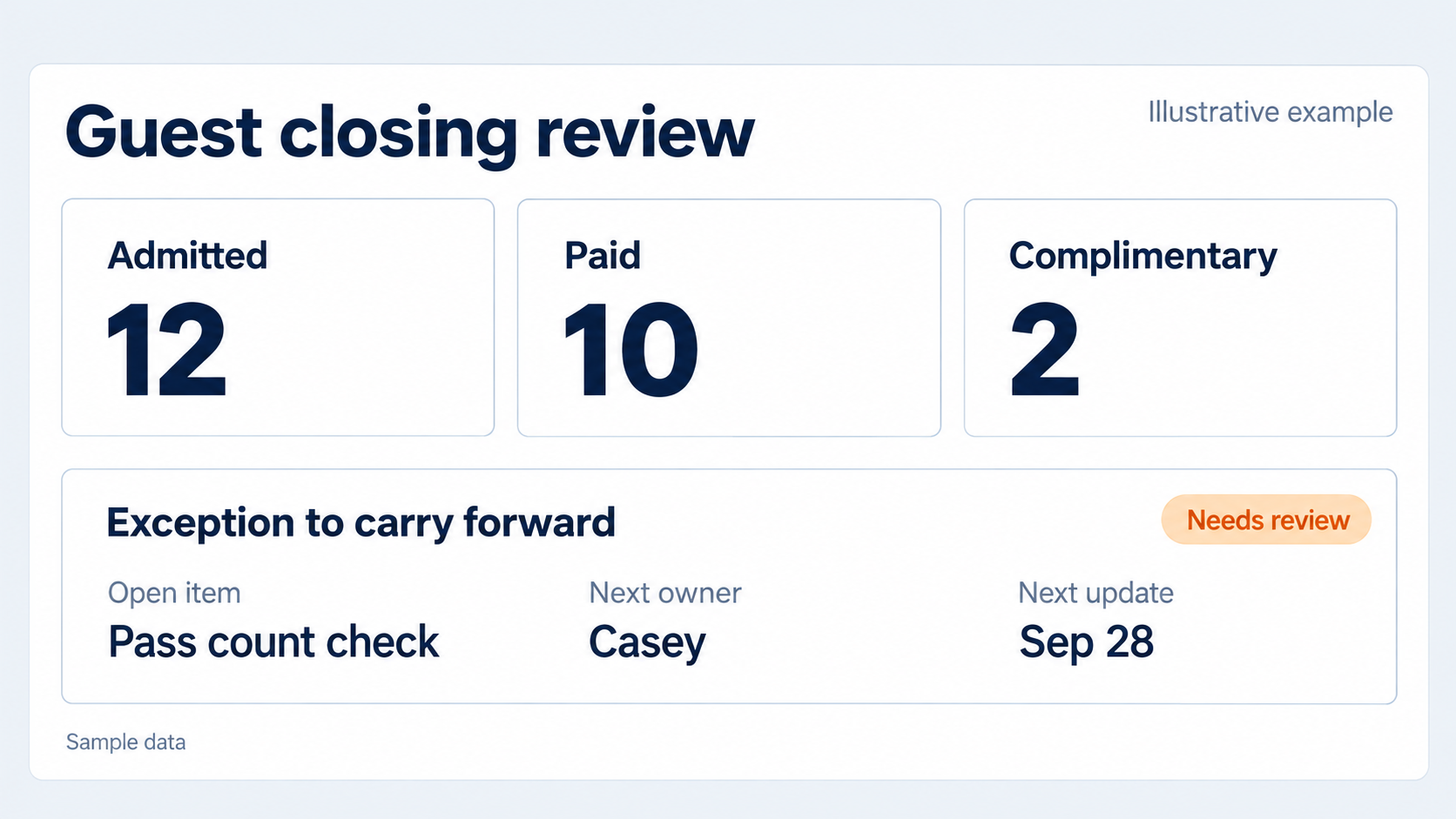
Your closing review should explain the relationship between admissions, pass use and payments. Those totals do not have to be identical. Someone may purchase passes for a future date, or a guest may have an approved complimentary visit.
Start with admitted visits and confirm the required sponsor, admission type and decision are recorded. Then review unresolved visits, cancellations, duplicate corrections and exceptions. Check which items still need a payment decision or pass adjustment.
Use a short handoff with three parts:
- Reviewed: Which period and records were checked?
- Open: What remains unresolved, with a reference to the relevant visit or transaction?
- Owner: Who will take the next action, and when?
For example: “One canceled visit needs review under the refund policy. The manager owns the decision tomorrow. No refund has been promised.” If an exception ended at closing, say so. The next shift should be able to distinguish a completed decision from a task that still needs attention.
Put the handoff where staff already look at the start of a shift. A detailed note in an overlooked conversation does little for the person working the entrance. Use visit references rather than copying guest details into multiple messages.
Rehearse the moments that need a decision
Before the next busy period, walk through these cases with the team. Ask someone who did not participate to read the resulting records and explain what happened.
- Ordinary arrival: An eligible member brings a guest with the correct pass. Can staff complete the process and identify the admission record?
- Claimed approval: A member says a manager made an exception, but the desk cannot find it. Who decides, and what happens while staff wait?
- Changed plan: Payment is complete, but the guest leaves before entering. Can staff separate the visit correction from the payment decision?
- Duplicate record: Two employees start entries for the same arrival. Can they preserve one accurate account?
- Unavailable records: Staff temporarily cannot reach the normal reference. Can they follow the approved fallback and reconcile afterward?
For that last case, define in advance which activities can continue, which require a manager and which must wait. Keep a temporary log with the minimum required visit details. Assign someone to reconcile it when access returns, including checking duplicates and related payments or pass use.
If a scenario only works because your most experienced employee remembers an unwritten rule, add the missing instruction. If nobody is available to approve an exception, fix the coverage arrangement before relying on the process.
Choose one improvement to put into use first. If missing approvals are the recurring issue, standardize the exception note and its location. If the confusion begins with payments, agree on the transaction lookup and review process. Assign an owner to explain the change at the next shift handoff.
After the next busy period, review a small selection of ordinary visits and exceptions. Count how many required a second explanation, how many still lack an outcome and how many open tasks have no owner. These are questions about your own records, not targets borrowed from another club. Use what you find to choose the next adjustment.
Keep changes visible to the team. Write down what changed, when it took effect and where staff can find the current guide. Close the loop with the employees who raised the issue so they can see the answer they should use next time.
See how the workflow fits together in Clubward
The practical question is whether your team can find the context behind an arrival. Clubward's front desk workflow includes member lookup, household and membership review, available guest passes and recent check-in activity. That gives you specific areas to examine against your own desk checklist.
Clubward's guest pass workflow connects guest products and redemption rules with sponsoring households and redemption history. Review your guest types, limits and schedules during setup rather than assuming every club handles them the same way.
Capabilities vary by plan and selected modules, as described on the front desk overview. Confirm the details that matter to your operation, including how staff will handle approvals, corrections and follow-up tasks.
Choose a time for a Clubward demo and bring your guest policy plus two examples: an ordinary arrival and an exception. Use those visits to walk through what staff knows before entry, what gets recorded and what the next shift can see. Leave with a clear view of the workflow your team would use on its next busy day.
From Katelyn Pauley
More from Clubward